西维蜀黍

【Kafka】消费过程(Consume)

Consumer Models

通常来讲,消息模型可以分为两种, 队列和发布-订阅式。

  • 队列(queue)的处理方式是 一组消费者从服务器读取消息,一条消息只有其中的一个消费者来处理。
  • 在发布-订阅模型中,消息被广播给所有订阅该消息的消费者,接收到消息的消费者都可以处理此消息。

Kafka为这两种模型提供了单一的消费者抽象模型: 消费者组(consumer group)。

  ...


【Kafka】复制(Replication)

Replication

  ...


【Kafka】压缩(Compression)

  ...


【Kafka】持久化(Persistence)

Retention

A key feature of Apache Kafka is that of retention, which is the durable storage of messages for some period of time. Kafka brokers are configured with a default retention setting for topics, either retaining messages for some period of time (e.g., 7 days) or until the partition reaches a certain size in bytes (e.g., 1 GB). Once these limits are reached, messages are expired and deleted. In this way, the retention configuration defines a minimum amount of data available at any time. Individual topics can also be configured with their own retention settings so that messages are stored for only as long as they are useful. For example, a tracking topic might be retained for several days, whereas application metrics might be retained for only a few hours. Topics can also be configured as log compacted, which means that Kafka will retain only the last message produced with a specific key. This can be useful for changelog-type data, where only the last update is interesting.

  ...


【Kafka】性能调优(Tuning)

Producers

acks

  • 参数说明:对于 Kafka Producer 来说是一个非常重要的参数,它表示指定分区中成功写入消息的副本数量,是 Kafka 生产端消息的持久性的保证。

max.request.size

  • 参数说明:这个参数对于 Kafka Producer 也比较重要,表示生产端能够发送的最大消息大小,默认值为1048576(1M)
  • 调优建议:这个配置对于生产环境来说有点小,为了避免因消息过大导致发送失败,生产环境建议适当调大,比如可以调到10485760(10M)

retries

  • 参数说明:表示生产端消息发送失败时的重试次数,默认值为0,即不重试。这个参数一般是为了解决因系统瞬时故障导致的消息发送失败,比如网络抖动、Leader 选举及重选举,其中瞬时的 Leader 重选举是比较常见的。因此这个参数的设置对于 Kafka Producer 就显得非常重要
  • 调优建议:这里建议设置为一个大于0的值,比如3次。
  ...


【Kafka】生产过程(Produce)

Produce

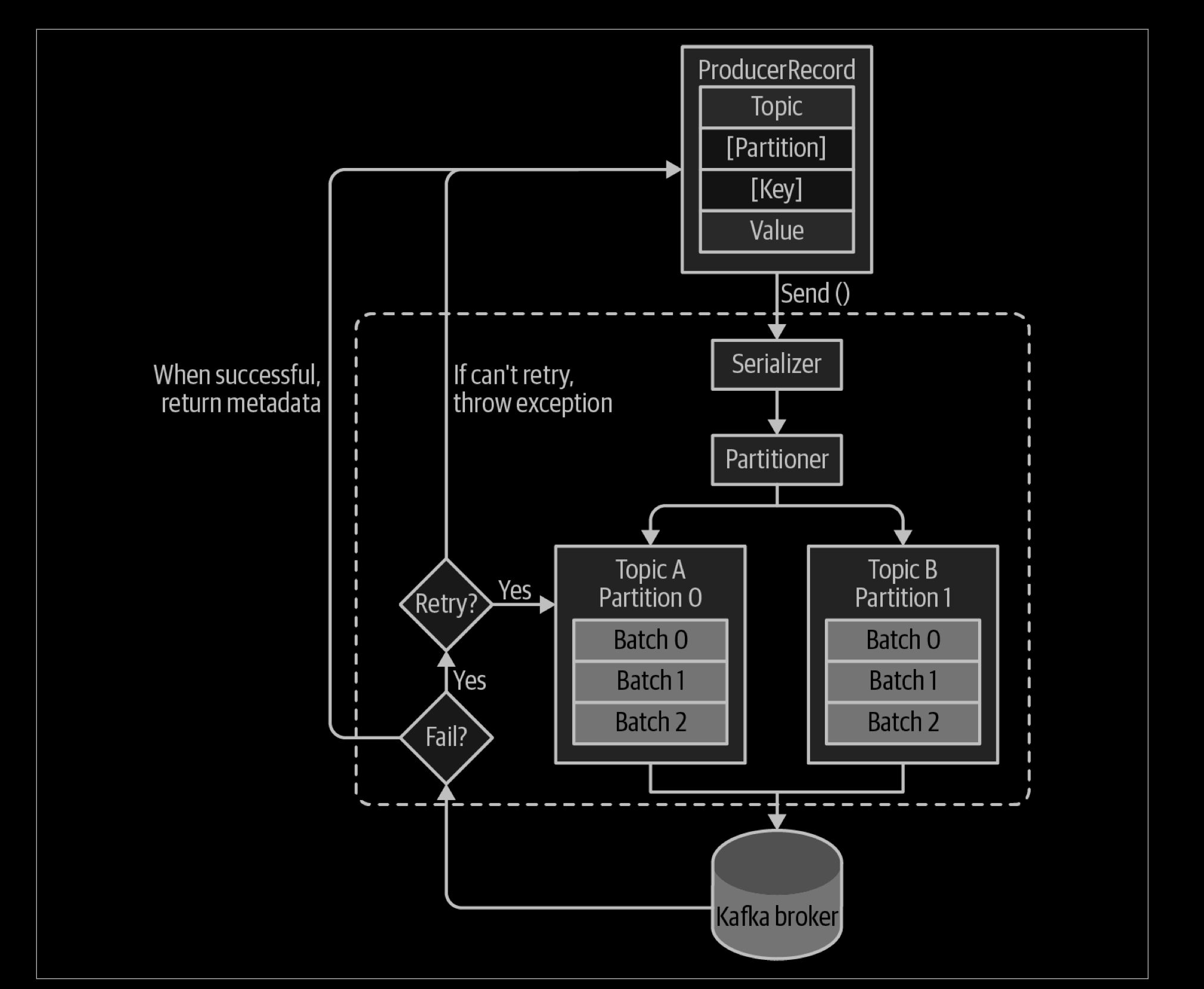
We start producing messages to Kafka by creating a ProducerRecord, which must include the topic we want to send the record to and a value. Optionally, we can also specify a key, a partition, a timestamp, and/or a collection of headers. Once we send the ProducerRecord, the first thing the producer will do is serialize the key and value objects to byte arrays so they can be sent over the network.

Next, if we didn’t explicitly specify a partition, the data is sent to a partitioner. The partitioner will choose a partition for us, usually based on the ProducerRecord key. Once a partition is selected, the producer knows which topic and partition the record will go to. It then adds the record to a batch of records that will also be sent to the same topic and partition. A separate thread is responsible for sending those batches of records to the appropriate Kafka brokers.

When the broker receives the messages, it sends back a response. If the messages were successfully written to Kafka, it will return a RecordMetadata object with the topic, partition, and the offset of the record within the partition. If the broker failed to write the messages, it will return an error. When the producer receives an error, it may retry sending the message a few more times before giving up and returning an error.

  ...

【Linux】命令 - netstat

# List all ports:
$ netstat -a

# List all listening ports:
$ netstat -l

# Display PID and program names for a specific protocol:
$ netstat -p <protocol>
  ...


【Distributed System】消息队列 - 避免消息重复消费(Idempotent Consumers)

  • 比如你拿个数据要写库,你先根据主键查一下,如果这数据都有了,你就别插入了,update 一下好吧。
  • 比如你是写 Redis,那没问题了,反正每次都是 set,天然幂等性。
  • 比如你不是上面两个场景,那做的稍微复杂一点,你需要让生产者发送每条数据的时候,里面加一个全局唯一的 ID(可以通过雪花算法去实现),类似订单 id 之类的东西,然后你这里消费到了之后,先根据这个 id 去比如 Redis 里查一下,之前消费过吗?如果没有消费过,你就处理,然后这个 id 写 Redis。如果消费过了,那你就别处理了,保证别重复处理相同的消息即可。
  • 比如基于数据库的唯一约束来保证重复数据不会重复插入多条。因为有唯一约束了,重复数据插入只会报错,不会导致数据库中出现脏数据。
  ...


【Kafka】如何避免消息丢失

Kafka 的已提交的消息(committed message)

一句话概括,Kafka 只对已提交的消息(committed message)做有限度的持久化保证。

已提交的消息

什么是已提交的消息?当 Kafka 的若干个 Broker 成功地接收到一条消息并写入到日志文件后,它们会告诉 Producer 这条消息已成功提交(ACK)。此时,这条消息在 Kafka 看来就正式变为“已提交”消息了。

那为什么是若干个 Broker 呢?这取决于你对“已提交”的定义。你可以选择只要有一个 Broker 成功保存该消息就算是已提交,也可以是令所有 Broker 都成功保存该消息才算是已提交。不论哪种情况,Kafka 只对已提交的消息做持久化保证这件事情是不变的。

有限度的持久化保证

也就是说 Kafka 不可能保证在任何情况下都做到不丢失消息。

有限度其实就是说 Kafka 不丢消息是有前提条件的。假如你的消息保存在 N 个 Kafka Broker 上,那么这个前提条件就是这 N 个 Broker 中至少有 1 个存活。只要这个条件成立,Kafka 就能保证你的这条消息永远不会丢失。

  ...


【Distributed System】消息队列 - 避免消息丢失

如何观察到消息发生丢失

我们可以利用消息队列的有序性来验证是否有消息丢失。原理非常简单,在 Producer 端,我们给每个发出的消息附加一个连续递增的序号,然后在 Consumer 端来检查这个序号的连续性。

如果没有消息丢失,Consumer 收到消息的序号必然是连续递增的,或者说收到的消息,其中的序号必然是上一条消息的序号 +1。如果检测到序号不连续,那就是丢消息了。还可以通过缺失的序号来确定丢失的是哪条消息,方便进一步排查原因。

如果是在一个分布式系统中实现这个检测方法,有几个问题需要你注意。

首先,像 Kafka 和 RocketMQ 这样的消息队列,它是不保证在 Topic 上的严格顺序的,只能保证分区上的消息是有序的,所以我们在发消息的时候必须要指定分区,并且,在每个分区单独检测消息序号的连续性。

如果你的系统中 Producer 是多实例的,由于并不好协调多个 Producer 之间的发送顺序,所以也需要每个 Producer 分别生成各自的消息序号,并且需要附加上 Producer 的标识,在 Consumer 端按照每个 Producer 分别来检测序号的连续性。

Consumer 实例的数量最好和分区数量一致,做到 Consumer 和分区一一对应,这样会比较方便地在 Consumer 内检测消息序号的连续性。

  ...